Coastal Views
Best Time of Day for Coastal View Photos: A Seasonal Light Guide
Stand on the same stretch of cliff at seven in the morning and again at seven in the evening and you might doubt you are looking at the same coastline. At dawn the water reads as a flat sheet of pewter and the rocks look scrubbed and grey. By evening those rocks have gone amber, the sea has a texture you could run a hand across, and the whole bay seems to be holding its breath. Nothing has changed except the angle of the sun — and that angle decides almost everything about how a coastal view photographs.
What follows is a walk through the four broad kinds of light you meet on a coast, then through the seasonal shifts that move them around the calendar. Fewer wasted mornings, better odds of being on the headland when the light does something worth keeping.
Morning: Clean Air, Cool Colour, Sharp Edges
Overnight the land loses heat and the air above it settles. Haze and moisture drop out of suspension, which is why distant headlands often look more defined at dawn than at any other hour. Colour leans cool — blues, blue-greens, grey-lilac — and contrast stays low until the sun clears the horizon.
The most useful window usually runs from about twenty minutes before sunrise to two hours after. The light is low and directional, shadows are long, and the sea is often calmer than it will be later, because the thermal breeze that builds through the afternoon has not started yet. Wet sand at low tide turns into a mirror; wet rock picks up a sheen.
What morning light does well
- Mist and sea fog, especially when you shoot into the light and let the sun burn through as a soft glow.
- Long shadows raking across a beach, which give flat sand a sense of shape.
- Calm water for reflections in sheltered coves and harbours.
- Cool palettes, if you want a quiet image rather than a postcard.
Scout the location the previous afternoon so you are not choosing a composition in the dark. Expose for the brightest part of the sky and let the foreground fall a little dark if you must; a slightly moody foreground is nearly always better than a blown-out sky.
Midday: Flat, Honest and Harder Than It Looks
Around the middle of the day the sun is high, shadows are short and contrast climbs steeply. Colours are vivid, but the sea can lose its modelling — a big blue expanse with nothing in it. This is the hour when a coastal view most often looks like a postcard nobody chose.
It is not a write-off. A polarising filter earns its keep at midday, when it is most effective at cutting glare from water and wet rock at roughly ninety degrees to the sun. Turn it slowly and watch the surface of the sea; the difference between a milky reflection and water you can see into is often a quarter turn. Be careful with very wide lenses, where the effect across a large sky can look uneven.
Where midday light works
Get close and get specific. Rock pools, pebbles, painted boats, harbour walls, fishing nets, the grain of weathered timber — all of these handle hard light well, and the short shadows help separate shapes. Shooting from a high clifftop also works, because the downward angle takes most of the sky out of the frame.
If the sky is overcast at midday, you have been handed the largest softbox on earth. Grey cloud scatters light evenly, which suits detail, wildflowers on the cliff path and anything with subtle colour. An overcast noon is a far better time for close work than a clear one.
Golden Hour and the Long Afterglow
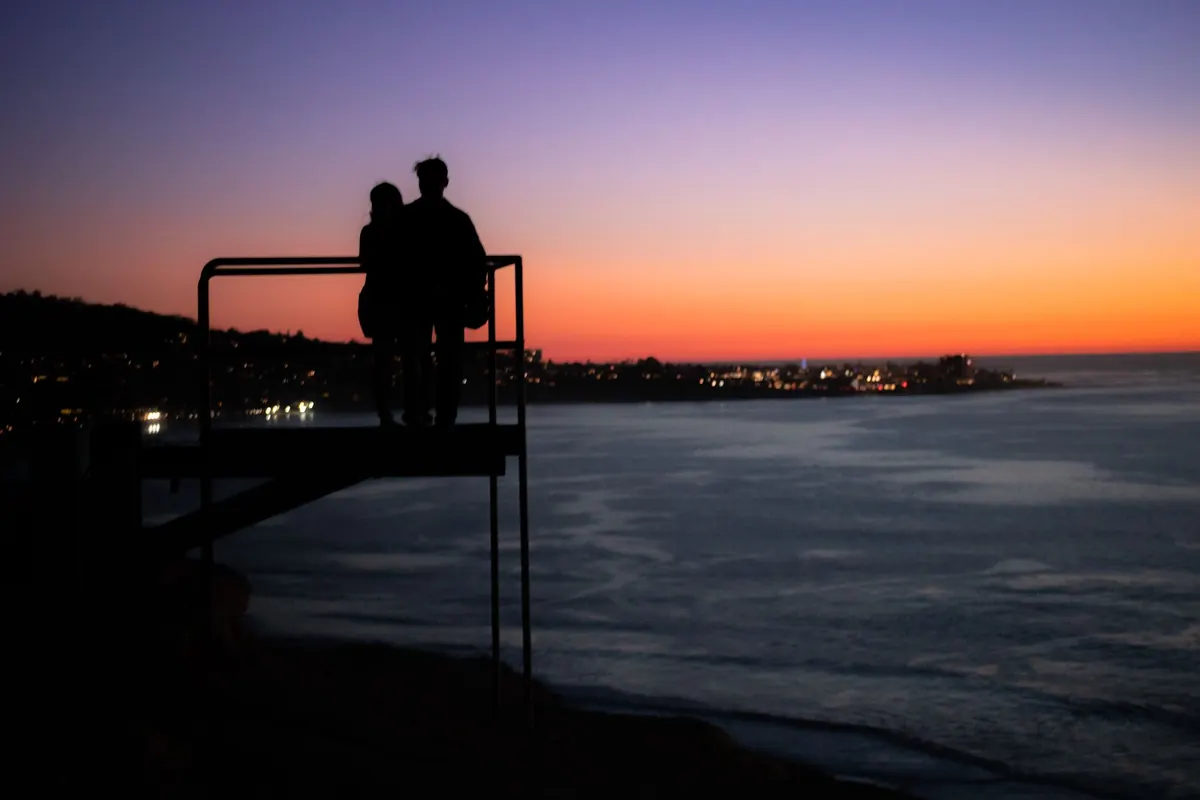
Everyone knows the hour before sunset. What surprises people on the coast is how long it lasts. Over open water there is no ridge or treeline to cut the sun off early, so the light stays low and warm until the disc actually touches the horizon — and on a west-facing shore it can sit just above that line for a while.
This is the light for silhouettes: a figure on a breakwater, a row of pines on the headland, spray coming off the rocks with the sun behind it. It is also the light that makes pale stone, dry grass and bare feet look like they belong in a magazine.
Then turn around. The view away from the sunset is often the better photograph. When the sun is low in the west, east-facing cliffs are lit by warm light bouncing off cloud and sky — gentler, more even, and usually less crowded with other photographers.
Stay put for another half hour. The twenty to forty minutes after sunset bring sky and harbour lights into something close to balance, and it is the only time of day when a working port photographs as well as a wild bay.
How the Seasons Move the Light
The sun does not rise and set in the same place all year. On a coastline of coves facing different directions, that matters more than the clock does.
Spring and autumn
Around the equinoxes the sun rises close to due east and sets close to due west. These are the weeks when narrow coves and steep-sided inlets finally get direct light down to the water. If you have found a bay that looked flat and lifeless in July, go back in April or October.
Summer
Sunrise comes early and sunset late, and the sun tracks far round to the north-east and north-west. That makes north-facing beaches — often the ones with the biggest swell — viable at both ends of the day. The trade-off is a very high sun at noon and a long stretch of afternoon that is bright but uninteresting. Twilight lingers, so evening sessions can run well past sunset.
Winter
A low sun all day means warm raking light even at midday and greatly extended golden hours on clear days. The sun stays in the southern part of the sky, so south-facing shorelines get the most direct light. Winter also brings the weather that makes coastal photography worth the cold: fronts clearing, broken cloud, big swell and clean air behind a storm. Bring more layers than you think you need, and a cloth for the lens.
Matching the Light to the View
Before you pick a time, work out which way the view faces. A compass or a map is enough.
- Note the bearing of the scene. A beach facing west is a sunset location; a cove facing east is a sunrise one; a north-facing bay is best in summer and dramatic in winter weather.
- Decide what you want from the picture. Silhouette and colour: golden hour. Texture and detail: overcast or early morning. Glassy water: dawn, or a windless evening.
- Check the sunrise and sunset direction for your date. In summer the sun sets noticeably further north than in December, which can put it behind a headland instead of beside it.
- Check the tide. Low water gives wet sand, exposed rock and reflection; high water gives more sea and fewer footprints, but less room to stand. A tidal range of a metre or two changes a composition completely.
- Arrive early and stay late. Thirty minutes before the light is right and thirty after. The best moment is rarely the one you planned for.
Weather Is Part of the Light
Clear skies are the least interesting conditions on a coast, because there is nothing for the light to catch. Broken cloud is better: gaps let warm light through in patches and the sea goes from grey to silver and back within a minute. A clearing storm is better still — hard air, saturated colour, and a decent chance of a rainbow if you are facing away from the sun.
Wind matters too. Onshore wind brings spray and atmosphere; offshore wind flattens the sea towards glass. Sea haze softens distant headlands into layers, which can be exactly what a wide view needs and exactly what ruins a long-lens shot of a far island.
A Simple Plan for Your Next Coastal Shoot
Pick one location, not five. Check which way it faces, look up the sunrise direction and the tide, then commit to either the morning or the evening window rather than trying to cover both. Arrive early, walk the scene without the camera first, and settle on two compositions before the light arrives. Shoot the wide view, then move closer and work the details while the colour holds. Stay for the afterglow, and accept the walk back in the dark if that is what it takes.
Do that a handful of times across a year and you will start to read a coastline the way you read a clock — not by looking at the sun, but by knowing what the next twenty minutes will do to the water.
Photo: Thom Gonzalez / Pexels
Related Articles